Some places look as if someone reached for the saturation dial and kept turning. A hillside town in Morocco painted the blue of a swimming pool. An island in the Venetian lagoon where no two neighbors share a color. Mountains in western China striped like a layer cake, a hot spring in Wyoming ringed in orange and gold, and a lake in Western Australia that is, on a good day, properly pink.
Here is what the photos leave out: color keeps hours. Every one of these places has a time of day when it glows and a time when it goes flat, pale or hidden in steam, and the gap between the two is enormous. So for each of the five most colorful places we know, we give you the reason it is that color, the season and the hour it peaks, exactly where to stand, and where to sleep so you are already there when the light arrives.
They sit on five continents, and between them something is always in season. Pick the color you want and go!
✈ Trip at a Glance
Where
Morocco, Italy, China, the United States and Australia: five places on five continents
Best time
Each has its own season and its own best hour; see the table
Getting there
Gateways are Tangier, Venice, Zhangye, West Yellowstone and Geraldton
Pace
One or two nights each, added to a bigger trip nearby
Budget
$$ to $$$ Varies by stop
Worth it if
You plan trips around light and will happily set an alarm for it
When the most colorful places in the world peak
The short version. Miss the hour and you will still see the place. Catch it and you will see the color.
| Place | Peaks | Stand here |
|---|---|---|
| Chefchaouen, Morocco | Spring and fall. Early morning in the lanes, sunset from above | The Spanish Mosque hill |
| Burano, Italy | All year. First thing in the morning, before the day boats | Tre Ponti bridge |
| Zhangye Danxia, China | June to September. The last hour before sunset | Viewing platform 4 |
| Grand Prismatic Spring, USA | June to September. A warm, sunny afternoon | The overlook on the Fairy Falls Trail |
| Hutt Lagoon, Australia | All year on a clear day. 10 am to 2 pm | Pink Lake Lookout |
1. Chefchaouen, Morocco: a whole town in blue

✈ The palette: haze, door teal, cornflower, cobalt, indigo
Chefchaouen sits high in the Rif Mountains of northern Morocco, and its old town is blue the way the sea is blue: in every shade at once. Walls, steps, doorways and flowerpots run from pale sky to deep indigo, and the lanes are narrow enough that the color closes over you like water. The town was founded in 1471, but the blue is younger than it looks. The account told most often credits Jewish refugees who arrived in the 1930s and painted their homes the color of the sky. A less poetic theory says the blue keeps mosquitoes away. Nobody can prove either one, and the town does not seem to mind. The walls get a fresh coat every spring, which is why the blue never looks tired.
Go into the medina early. Day visitors arrive from Tangier and Fes by late morning, and before they do the lanes belong to cats, bakers and people rinsing their front steps. It is also when the blue looks deepest: until the sun climbs high enough to reach down between the houses, the walls sit in soft, even shade with nothing to bleach them.
Where to look: Save the end of the day for the Spanish Mosque, a small white building on the bare hill east of town. The path starts by the Ras el-Maa spring at the edge of the medina and climbs for about half an hour. From the top you look west across the whole town as it spills down the opposite slope, blue and white against green mountains, with the sun dropping behind it. Bring water, and stay until the call to prayer drifts up from below.

When: March to May and September to November, for mild days and green hills Getting there: daily buses from Tangier and Fes; the nearest airport is Tétouan, about 30 miles away
✈ Where to stay: Lina Ryad & Spa for a rooftop terrace over the medina and a hammam, or Dar Echchaouen for gardens and a pool beside the Ras el-Maa spring. Or see all places to stay in Chefchaouen.
✈ Make a day of it: see medina walks and day trips to the Akchour waterfalls
2. Burano, Italy: every color at once

✈ The palette: tomato, apricot, lemon, lagoon blue, rose
Forty-five minutes by water bus from Venice, the island of Burano looks like a paint chart that learned to float. Fishermen’s cottages line the canals in tomato red, cobalt, mint, mustard and a pink that has no business working and somehow does. The story told on the island is that fishermen painted their houses brightly so they could pick out home through the lagoon fog. It is a legend, and a good one. The modern rule is better documented: owners are said to need permission before they repaint, and are offered a set of colors for their plot. That is how the island stays a patchwork.
Burano’s enemy is the middle of the day, when the boats from Venice unload and the main street fills. The cure is the clock. Take an early vaporetto, or better, stay the night. Once the day boats leave, the island goes back to laundry lines, moored boats and neighbors talking across the water, and in the morning you get every house twice: once on the bank and once, upside down, in a canal that nothing has disturbed yet.
Where to look: Start at Tre Ponti, the wooden bridge where three canals and three of the island’s brightest streets meet, and turn slowly. Every direction is a different palette. Then walk to the Terranova bridge for the leaning bell tower of San Martino, which tilts over the rooftops like a tall friend ducking into a photo. Last, find Casa di Bepi Suà, tucked just off Via Galuppi: the one house on the island painted in a quilt of geometric shapes.

When: all year on a clear day; weekday mornings are quietest Getting there: vaporetto line 12 from Fondamente Nove in Venice, about 45 minutes, by way of Murano
✈ Where to stay: Casa Burano for rooms in refurbished island houses, or Venissa Wine Resort for a walled vineyard on Mazzorbo, a ten minute walk over the footbridge. Or see all places to stay on Burano.
✈ Make a day of it: see lagoon boat tours of Murano, Burano and Torcello
3. Zhangye Danxia, China: the rainbow mountains

✈ The palette: rust, burnt orange, ochre, cream, sage
In Gansu province, along the old Silk Road, the hills outside the city of Zhangye are banded in rust, orange, cream and mustard, stripe after stripe, as if the land had been folded out of colored paper. The bands are layers of sandstone and minerals, laid down flat over millions of years, then tilted and worn open by wind and rain. Nothing here is painted and nothing is planted. This is what the ground looks like underneath, shown all at once.
Zhangye is the clearest case of color keeping hours. At noon the light is harsh and the hills can look dusty and pale. In the last hour before sunset the low sun rakes across the ridges, the reds deepen, shadows carve out every fold, and the whole valley seems to switch on. The colors are stronger again after rain, which is one reason June to September, when a very dry region gets what little rain it gets, is the season to come. Choose a clear evening. Under flat cloud the hills keep their colors to themselves.
Where to look: The main scenic area is toured by shuttle bus, which loops between numbered viewing platforms: you ride, climb some steps, look, and ride on. Most guides send you to platform 4 for sunset, and that is where we would be standing when the light turns. Platform 2 is the highest, with the widest view, so climb it earlier while your legs are fresh. Sunset comes late out here, around eight in the evening in summer, so there is no need to rush dinner.

When: June to September, at sunset, ideally the evening after rain Getting there: high-speed trains from Lanzhou (about three hours) and Xining (about two) stop at Zhangye West; the park is about 40 kilometers on
✈ Where to stay: base yourself in Zhangye city, about 40 kilometers from the park, or in the small visitor town by the north entrance if you want a short ride home after sunset. See all places to stay in Zhangye.
✈ Make a day of it: see guided day trips to the Danxia geopark from Zhangye
4. Grand Prismatic Spring, USA: a rainbow that is alive

✈ The palette: deep blue, turquoise, green, yellow, orange, rust
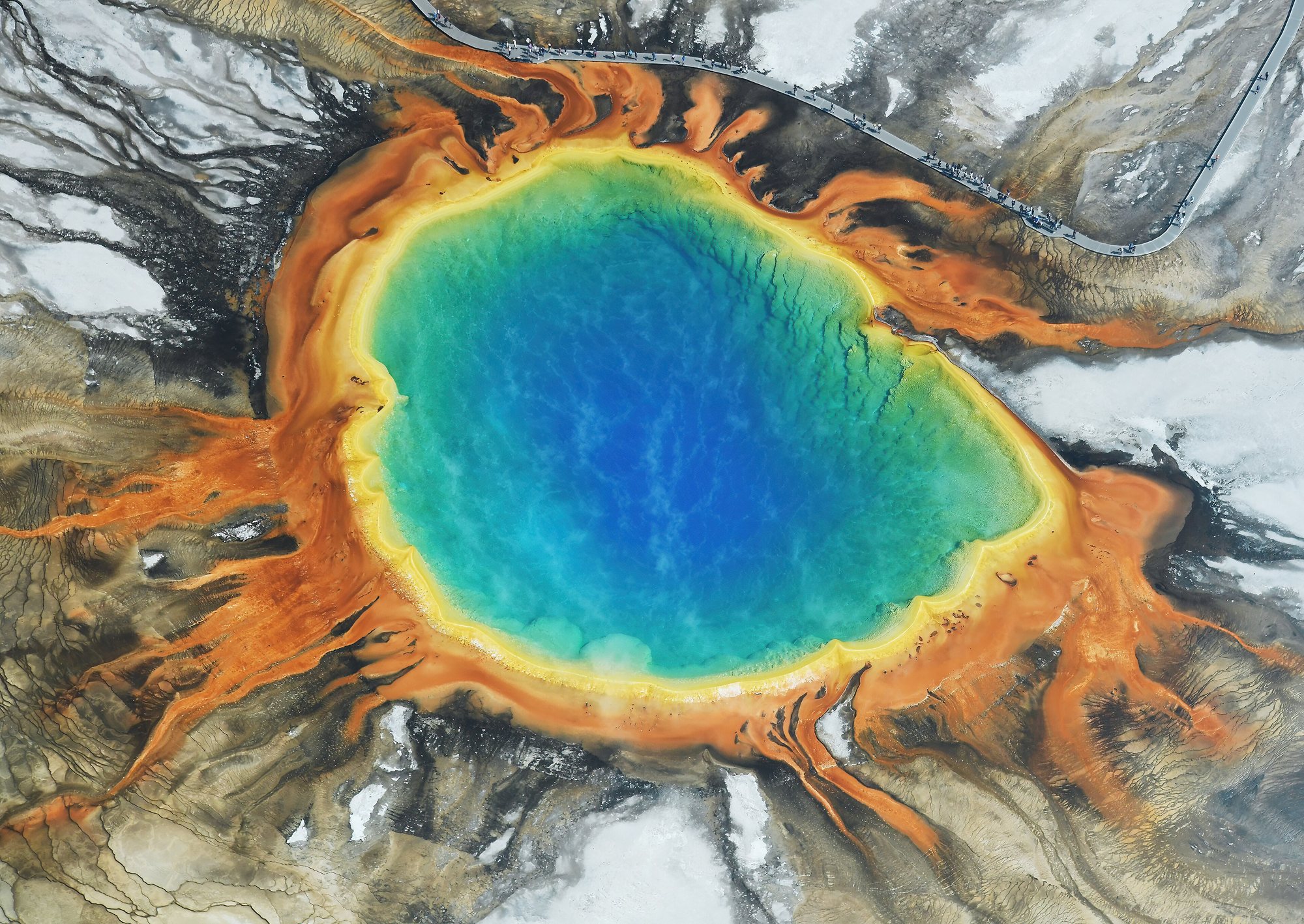
Yellowstone’s largest hot spring looks, from above, like a great blue eye with a burning rim. The center is a blue so deep it seems lit from below. Around it run rings of green, yellow, orange and rust, bleeding out across the ground in long fiery streamers. The National Park Service puts the spring at 200 to 330 feet across and more than 121 feet deep. The blue is the water itself, too hot at the center for much to live in. Everything else is alive: mats of heat-loving microbes called thermophiles, each kind settled at the temperature it likes best, so the colors shift in bands as the water cools toward the edge.
Here the thief is steam. On a cool morning the spring hides under its own cloud, and you can stand right beside it and see almost nothing. Wait for a warm, sunny afternoon, when the steam thins and the sun is high enough to light the pool to the bottom. It is the rare natural wonder that rewards sleeping in!
Where to look: Do not settle for the boardwalk. At ground level you are too close and too low to see the shape, like reading a billboard with your nose on it. Drive a mile south to the Fairy Falls trailhead and walk the gentle 0.6 miles up to the Grand Prismatic overlook, a platform on the hillside that takes in the entire spring, rings and all. That is the view in the photo above. Then go and do the boardwalk anyway, for the steam drifting across the planks and the orange a few feet from your shoes.

One note on timing. The road past the spring opens to cars in mid April and closes at the end of October, and the overlook trail sits in a bear management area that stays closed in spring until around Memorial Day weekend, so late May is the real start of the season. In winter the same road carries snowcoaches instead of cars, which is a different and wonderful trip. Our guide to Yellowstone in winter covers it.
When: June to September, on a warm, clear afternoon Getting there: West Yellowstone, Montana, is the nearest gateway town; Bozeman has the main airport
✈ Where to stay: Old Faithful Inn, about six miles south inside the park, is the classic, and it books up far ahead. Outside the gate, see all places to stay in West Yellowstone.
✈ Make a day of it: see guided Yellowstone day tours that include Grand Prismatic and Old Faithful
5. Hutt Lagoon, Australia: the pink lake

✈ The palette: bubblegum, blush, mauve, sand, sky blue
On Western Australia’s Coral Coast, about five and a half hours’ drive north of Perth, the road to the fishing village of Port Gregory runs beside a lake the color of strawberry milk. Hutt Lagoon is a salt lake, and its pink comes from an alga called Dunaliella salina, which makes beta carotene, the pigment that colors carrots and is used as a food dye. Depending on the day the water reads as bubblegum, lilac or a deep rosy red, with a white crust of salt at the edge and, just over the dunes, the hard blue of the Indian Ocean.
This one runs on the opposite clock to the others. Forget golden hour: the regional tourism board says the lake is most vivid on a sunny day between about 10 am and 2 pm, when the sun stands high over the water. Under cloud it can fade toward grey. It is pink all year, though heavy rain can leave it paler for a while, so the only real rule is to check the forecast and arrive for lunch.
Where to look: Pull in at the Pink Lake Lookout, an unsealed stopping place on Port Gregory Road where you can park safely and walk to the edge. Wear closed shoes, because the salt crust is sharp, and skip the swim: the tourism board says the water is not safe for it. If you want the whole sweep of color at once, scenic flights leave from Kalbarri and Geraldton and show the lagoon as one long pink ribbon beside the sea.

When: all year, on a clear day between 10 am and 2 pm Getting there: fly to Geraldton and drive about an hour north, or drive up from Perth; Kalbarri is 45 minutes farther on
✈ Where to stay: Port Gregory Caravan Park to sleep within a walk of the lake, or Kalbarri Edge Resort for a base in Kalbarri, with the national park gorges next door. Or see all places to stay in Kalbarri.
✈ Make a day of it: see scenic flights and day tours to the Pink Lake
How to chase color anywhere
Ask what steals it. Every colorful place has a thief. In Burano it is the midday crowd, at Zhangye the noon glare, at Grand Prismatic the morning steam, at Hutt Lagoon the cloud. Find out what dulls the place you are going to, then plan the day around avoiding it.
Sleep close. Three of these five are at their best at an hour when the day trippers are somewhere else. A room within walking distance buys you the first light, the last light, or both.
Give it two chances. Weather does not read itineraries. Build in a spare evening at Zhangye or a spare noon at the pink lake, and one grey sky will not cost you the trip. And if you are flying in over any of them, our guide to photographing from the window seat will help you bring some of the color home.
The most colorful places, quickly answered
What is the most colorful place in the world?
There is no single winner, because the colors come from such different sources. For natural color in one view, Grand Prismatic Spring is hard to beat. For a place people live in, Burano has the widest palette and Chefchaouen the deepest commitment to one shade. For sheer scale, nothing matches the striped hills of Zhangye Danxia.
Do these places really look like the photos?
Mostly yes, at the right hour, and that hour matters more than the camera. Some widely shared pictures, of Zhangye Danxia in particular, have had the saturation pushed past what the eye sees, and the hills in person are earthier. Arrive at sunset on a clear day and the real thing needs no help.
Is there one month that works for all five?
September comes closest. It falls inside the summer season for Zhangye Danxia and Grand Prismatic Spring and the fall season for Chefchaouen, while Burano and Hutt Lagoon are good in any month with clear skies. June is a strong second choice.
Can you swim in the pink lake or the hot spring?
No to both. The regional tourism board advises against swimming in Hutt Lagoon. Grand Prismatic Spring is scalding, the ground around it is fragile, and visitors must stay on the boardwalk at all times.
More from us in Natural Wonders, Europe, Asia and Africa & the Middle East. For one more color that looks impossible, see the blue of Canada’s Peyto Lake, and before you book the flight, check which side to sit on with the Window Seat Finder.
Sources: National Park Service, Grand Prismatic Spring; National Park Service, Yellowstone park roads; Australia’s Coral Coast; AFAR; Isola di Burano; China Highlights; China Discovery. Seasons, road dates and opening hours can change, so confirm locally before you travel. Lead photo: Carsten Steger, Wikimedia Commons, CC BY-SA 4.0.
Some hotel links on this page are affiliate links. If you book through them, The Window Seat may earn a small commission at no extra cost to you.


Leave a Reply