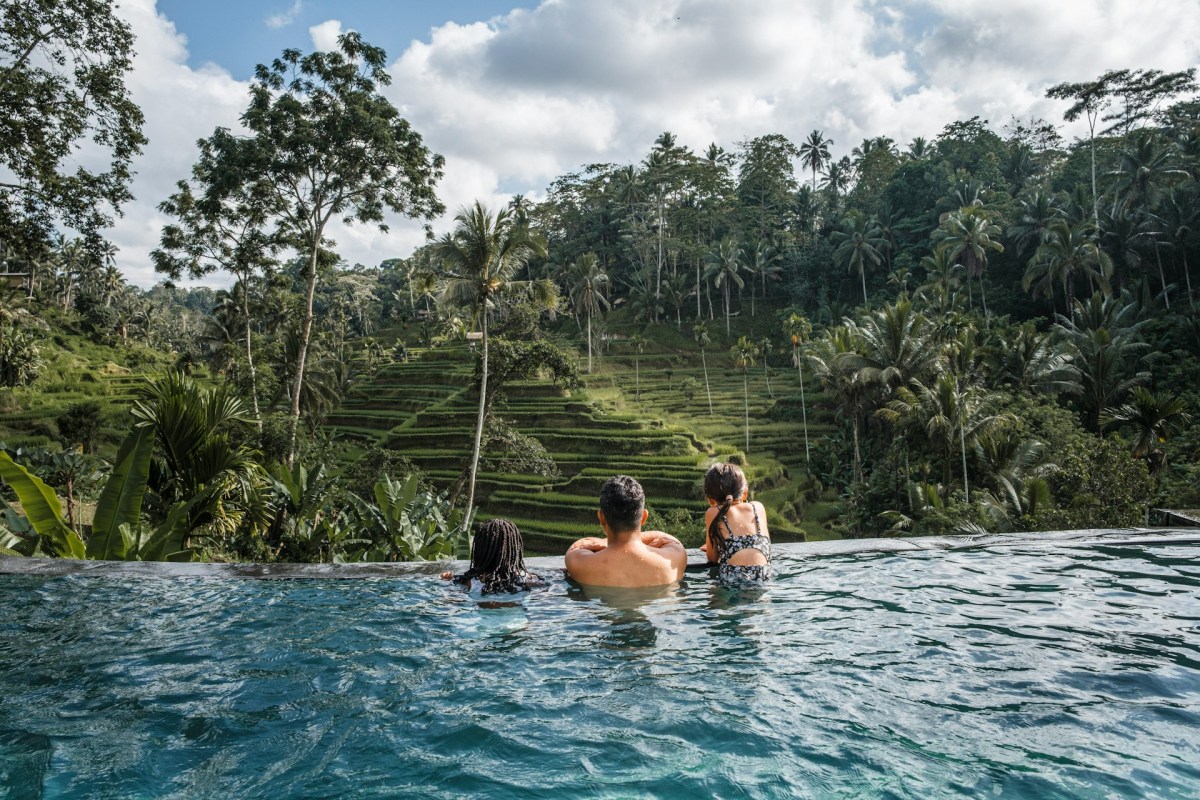
Bali has been many things to many people: a honeymoon destination, a yoga retreat, a digital nomad hub, a surf break. What it often isn’t, for first-time visitors who stick to Seminyak and Kuta, is the island the Balinese actually inhabit. That island — defined by its extraordinary Hindu culture, its intricate village social structures, and its landscapes of volcanic peaks and terraced rice paddies — is still very much here, and it’s accessible to anyone willing to venture beyond the resort corridor.
Where to Actually Stay
The south — Kuta, Seminyak, Canggu — is convenient but crowded. For a genuine sense of the island, base yourself in Ubud, the cultural heartland in Bali’s central highlands. Here, temple ceremonies spill into the streets, artisan workshops line the main roads, and rice paddies begin 10 minutes’ walk from the center. The Munduk area in the northern highlands offers cooler temperatures, coffee and clove plantations, and far fewer visitors. Sidemen Valley, east of Ubud, is perhaps Bali’s most photogenic corner — a slow curve of terraced rice fields backed by Gunung Agung — with excellent mid-range guesthouses and almost no package tourism.
Understanding the Village System
Every Balinese village is organized around the banjar — a community cooperative that manages temple maintenance, cremation ceremonies, religious festivals, and communal decisions. Visitors rarely see this structure, but it explains why Balinese culture has proved so durable in the face of mass tourism: it’s not just a set of traditions but a living social architecture, reproduced in every village across the island. When you’re invited to watch a temple ceremony (and you likely will be, if you spend time in a village rather than a resort), accept graciously — bring a sarong, wear it, and follow the lead of those around you.
The Temple Circuit
Bali has an estimated 20,000 temples — roughly one for every 100 residents. The most visited are Tanah Lot (dramatic ocean setting, very crowded), Uluwatu (clifftop, with a famous kecak fire dance at sunset), and Besakih (the “mother temple” on Agung’s slopes). But the most memorable temple experiences tend to be smaller ones: the water temple at Tirta Empul, where Balinese pilgrims purify themselves in spring-fed pools, or Pura Kehen in Bangli, a tiered mountain temple rarely reached by tour groups. Entry to most temples is free or involves a small donation; a sarong is required and usually available to borrow at the gate.
Getting Around
Bali is small enough to feel manageable but spread out enough to need a vehicle. Hiring a driver for the day (around $40–60 USD) is the most flexible option for getting between regions; drivers double as guides and can arrange temple access, market stops, and detours that no tour bus would make. Ride-hailing apps (Grab and Gojek) work well in the south and in Ubud. Renting a scooter makes sense if you’re experienced; the roads in the highlands are scenic but steep and often wet.
What to Eat — and Where
Warung — small, family-run restaurants — serve the island’s best food at a fraction of what any hotel charges. Nasi campur (rice with small portions of meat, vegetables, and sambal), babi guling (spit-roasted suckling pig), and lawar (a ceremonial minced meat dish with grated coconut) are the foundations of Balinese cooking. Ibu Oka in Ubud has become famous for babi guling; for a more local experience, follow the locals to whichever warung has the longest queue in the morning market. Breakfast at a local market, eaten standing up, costs about $1.50.
When to Go
Bali’s dry season runs from April through October, with July and August being peak tourist months. For fewer crowds and lower prices, May–June and September are ideal: weather is excellent and the island hasn’t yet filled with European summer holidaymakers. The wet season (November–March) brings afternoon rains but also Bali’s most lush and dramatic landscapes — and its most significant religious calendar, culminating in Nyepi (the Day of Silence) in March, when the entire island shuts down for 24 hours. Arriving for Nyepi is one of travel’s genuinely rare experiences.
The Bali that most travelers describe — hectic, commercialized, overrun — is real. But it occupies a narrow strip of the island’s southwest coast. The rest of Bali is still waiting, essentially intact, for anyone willing to look past the first impression.


Leave a Reply