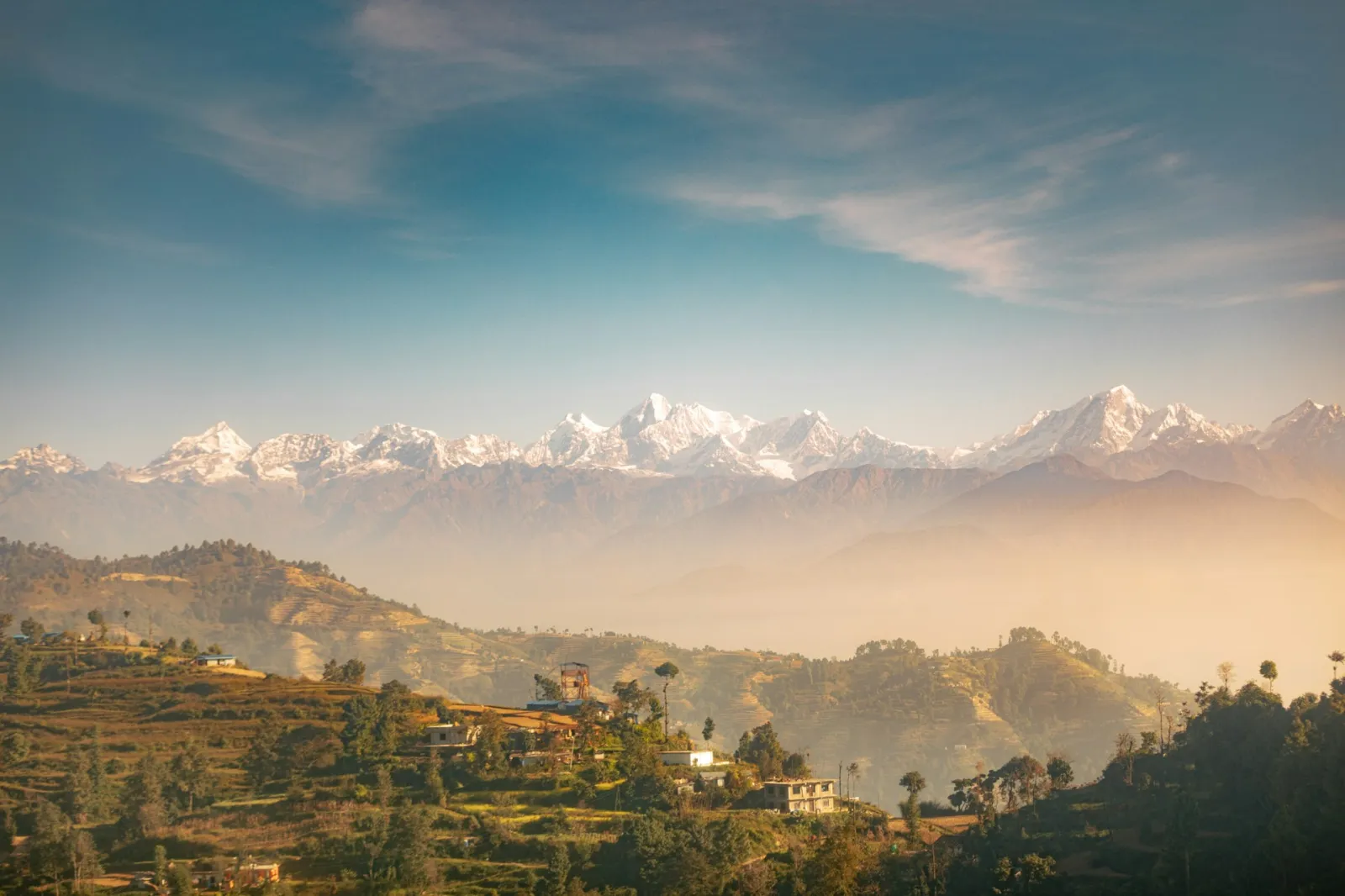
This Nepal travel guide is written for first-time visitors arriving without a pre-packaged tour — people who want to understand the country well enough to plan it themselves. It covers Kathmandu’s temple circuit, how to choose between the Everest Base Camp and Annapurna trekking routes, which permits you’ll need, realistic costs, and the best season to go.
Nepal occupies a geography that seems almost improbable: the Himalayas along its northern border, the subtropical Terai lowlands to the south, and the Kathmandu Valley at its center — a UNESCO World Heritage Site containing seven monument zones within a single metropolitan area. It is one of the most culturally dense and physically dramatic destinations on Earth, and it is considerably more accessible than its reputation for adventure suggests. You don’t need to be an experienced mountaineer to have a transformative experience here. You need a few days to acclimatize, a sense of pace, and some advance planning.
Getting There
Tribhuvan International Airport in Kathmandu is Nepal’s only international hub. Direct flights operate from the Gulf hubs (Dubai, Doha, Abu Dhabi), Delhi, Bangkok, and several Chinese cities; from Europe or North America, a one-stop routing through one of these is standard. Flying time from London is roughly 9 hours; from New York, 15–17 hours with a connection. Visa on arrival is available to most nationalities for $30 (15 days) or $50 (30 days) — apply online in advance at nepalimmigration.gov.np to save time at the airport. The best months to arrive are October–November (post-monsoon, clear skies, ideal trekking conditions) or March–April (spring wildflowers, slightly warmer).
Kathmandu and the Valley
Budget two to three days in Kathmandu before heading into the mountains — both to acclimatize to the altitude (1,400 meters) and to absorb one of Asia’s most extraordinary cities. Swayambhunath (the Monkey Temple), perched on a hilltop with views of the whole valley, is the best introduction to Newar Buddhist culture. Pashupatinath, the sacred Hindu cremation complex on the Bagmati River, is one of the most spiritually charged places in South Asia and is open to respectful non-Hindu visitors. The medieval squares of Patan and Bhaktapur, a 30-minute drive from Kathmandu center, are UNESCO-listed living cities where traditional Newari architecture has survived earthquakes, including the devastating 2015 quake that destroyed much of what was rebuilt over subsequent years. Stay in Patan — quieter and more walkable than central Kathmandu — if you can.
Choosing a Trek: EBC vs. Annapurna
The two great trekking circuits are the Everest Base Camp route and the Annapurna Circuit, and they’re genuinely different experiences. The EBC trek (12–14 days from Lukla, reaching 5,364 meters at Base Camp) is more dramatic in its mountain scenery and Sherpa culture but more crowded and logistically constrained — you fly to Lukla and retrace your steps, or exit via helicopter. The Annapurna Circuit (15–20 days, max elevation at Thorong La Pass: 5,416 meters) is a complete loop through more diverse landscapes: rice terraces, pine forests, high alpine desert, and the subtropical Marsyangdi valley. For first-timers with two to three weeks, the Annapurna Circuit offers more variety. Both require a TIMS card ($20) and the relevant national park permit ($30–35). Hiring a guide ($25–35/day) and porter ($15–20/day) is not required but strongly recommended — it supports local livelihoods and makes logistics significantly easier.
Chitwan and Pokhara
Nepal isn’t only Kathmandu and mountains. Chitwan National Park in the Terai lowlands is one of the best places in Asia to see one-horned rhinoceroses and Bengal tigers, with jeep safaris and dugout canoe trips available through the park’s buffer zone lodges. Pokhara, five hours west of Kathmandu by road or 25 minutes by air, is the gateway to the Annapurna range and a destination in its own right: a lakeside town with a laid-back traveler culture, excellent food, paragliding, and the most consistently spectacular sunrise view of Machhapuchhre (Fishtail Mountain) from the Sarangkot ridge. Budget a minimum of two nights here.
Practical Notes
Nepal is inexpensive by any measure: a comfortable guesthouse runs $15–40/night, a full teahouse meal on the trail $5–8, a local bus between cities a few dollars. Budget travelers can get by on $40/day; those wanting more comfort can do so well for $80–100. Cash (Nepali rupees) is essential outside Kathmandu — ATMs exist in Pokhara and Namche Bazaar but can be unreliable on the trail. Altitude sickness is a real consideration for any trek above 3,500 meters: ascend slowly, take rest days, and don’t ignore symptoms (headache, nausea, confusion). The basic rule is never sleep at a higher altitude than you woke up at if you’re feeling unwell.
Nepal rewards the kind of attention that leaves room for detour and delay — a festival that appears in the street, a teahouse conversation that runs until dark, a ridge view that holds you longer than your schedule intended. Build more time than you think you need. You will use it.


Leave a Reply